



By BRIAN DONOHUE
Red Bank, the headline exclaimed, had gone “fight crazy.”
And for good reason.
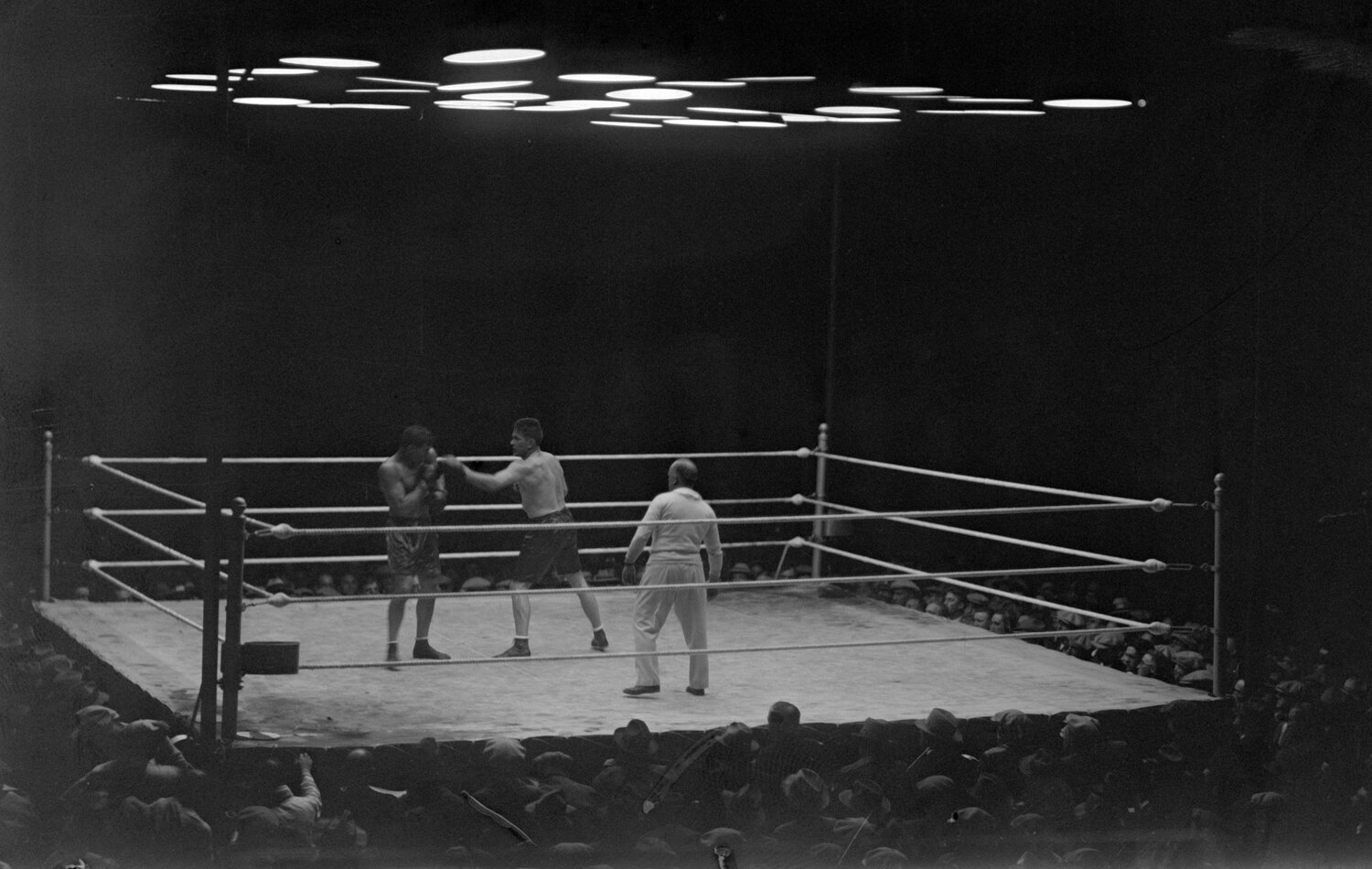
One hundred years ago this week, boxer Gene Tunney defeated Jack Dempsey for the heavyweight championship of the world in front of 135,000 fans, including busloads of his Red Bank neighbors, in the pouring rain at Philadelphia’s Sesquicentennial Stadium.
The fight threw the town into a frenzy, the paper reported. Those who didn’t hop the buses or trains to Philly gathered in shops and “radio house parties” to hear the broadcast of the bout. 
“Scores of Red Bankers know Tunney and everyone who knows him likes him,” the story continued. “He owns property at Red Bank and he does most of his banking here. Added to this is the glamor of a world record, a likeable disposition and an education not commonly associated with prize fight champions.”
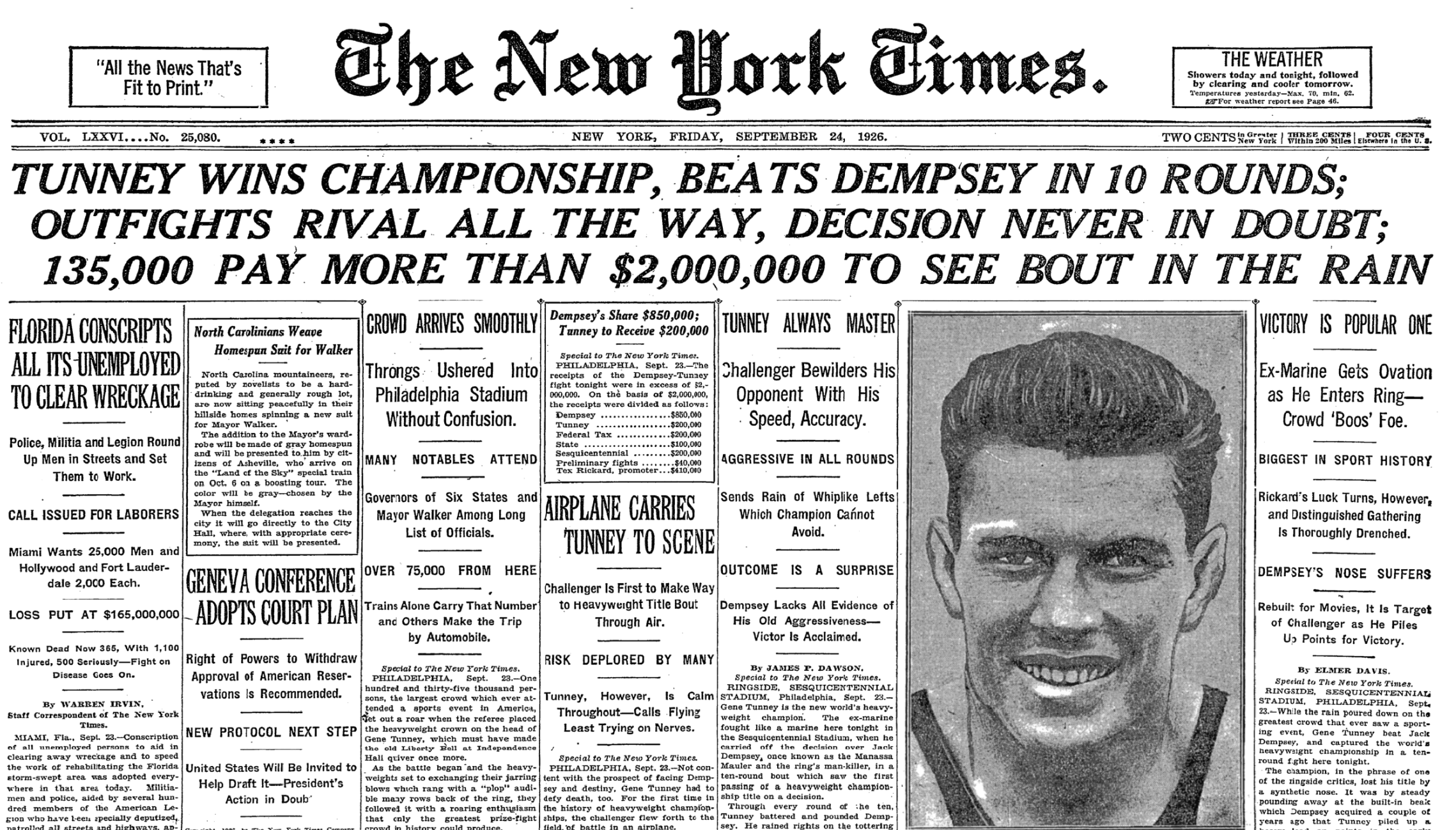 Tunney’s victory over Dempsey for the heavyweight championship warranted a triple-deck banner headline across page A1 of the New York Times.
Tunney, a US Marine Veteran of World War I known for quoting Shakespeare, was being hailed as a hero.
While many places no doubt wanted to claim him, Red Bank had as legitimate a claim as any – or at least his native New York City.
A 1924 New York Times article about Tunney training for a fight against French boxer Georges Carpentier said he was training at his “private gymnasium and camp in Red Bank, NJ.”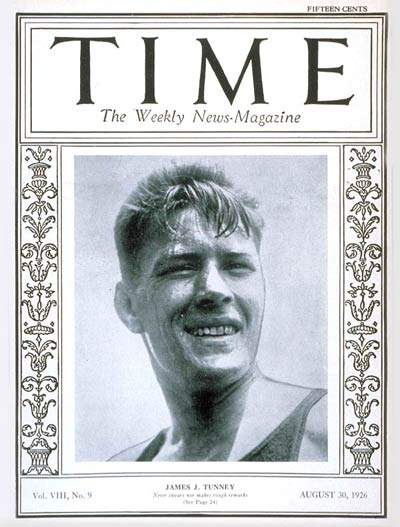
Raised in New York City, Tunney moved to Monmouth County at the invitation of trucking magnate Harry McCormack, who owned a farm at Scobeyville, according to the Register, whose digital archives are maintained by the wonderful Red Bank Public Library.
Another Register article from the era describes him as a “Red Bank resident” but also a resident of Greenwich Village, where he grew up.
And a 1924 story describes him training at the “Shrewsbury River Country Club” a short-lived facility in the River Plaza section of Middletown. A 1927 Register article described him as a member of the “Red Bank lodge of Elks.”
By 1924, the Register reported Tunney and McCormack owned “The Wikof place tract in Red Bank, which was recently opened up between Broad Street and Maple Avenue.” It continued: “He is also one of the owners with Harry McCormack of the triangular tract of land on the west side of Broad Street at the junction of that street with the railroad.”
And so, when he squared off against Dempsey, Red Bank went nuts. Or they went to Philadelphia to see the fight in person.
“Doctors, lawyers, merchants, chefs and every other profession and walk of life at Red Bank will be represented,” the paper reported the week before the fight as residents made travel plans.
When the day arrived, shopkeeper Mort. V. Patch, “had a radio outfit in front of his store which gave the fight returns blow by blow. A big crowd gathered in front of the store to hear the news.”
The story continues, “At other places in town where similar returns were announced, there were big crowds. There were many radio parties at private residences, where folks gathered to hear the ringside news. Radio dealers report having done extra business last week in getting machines tuned up and put into readiness for the fight returns. They also report having had a bigger sale of receivers than usual last week.”
Tunney moved to Connecticut after he retired. He died in 1978.
Tunney’s Wikipedia entry quotes Muhammad Ali’s 2015 book “Muhammad Ali: Portrait of a Champion, praising Tunney’s style.
“If you look at Tunney, it’s where boxing started to get better. He throws punches sharp and quick. Strong, fast and quick. He’s about the best of the old timers. I’d say Tunney is the greatest old timer as far as punching and skill is concerned.”
Must be in the water around here.
redbankgreen editor Brian Donohue may be reached via email at [email protected] or by calling or texting 848-331-8331.