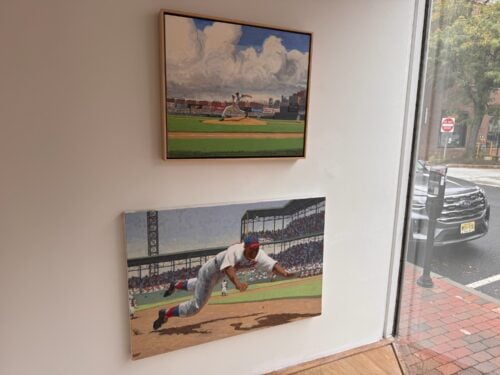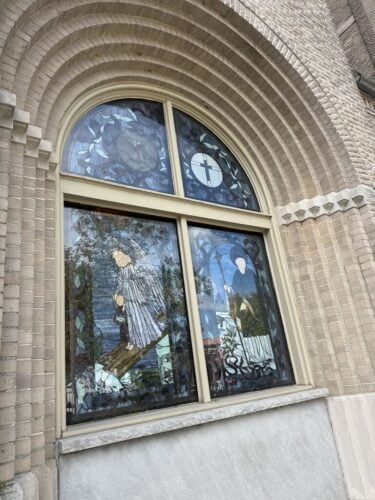




 Gallery Lucida at 18 Wallace Street. (Photo by Brian Donohue. Click to enlarge.)
By LILLY WARD
Since opening last November, Gallery Lucida on Wallace Street has established itself as a fixture in the local arts scene, introducing Red Bank to a number of up and coming artists from New York and piquing interest with exhibitions that feature artists from as far afield as Minneapolis.
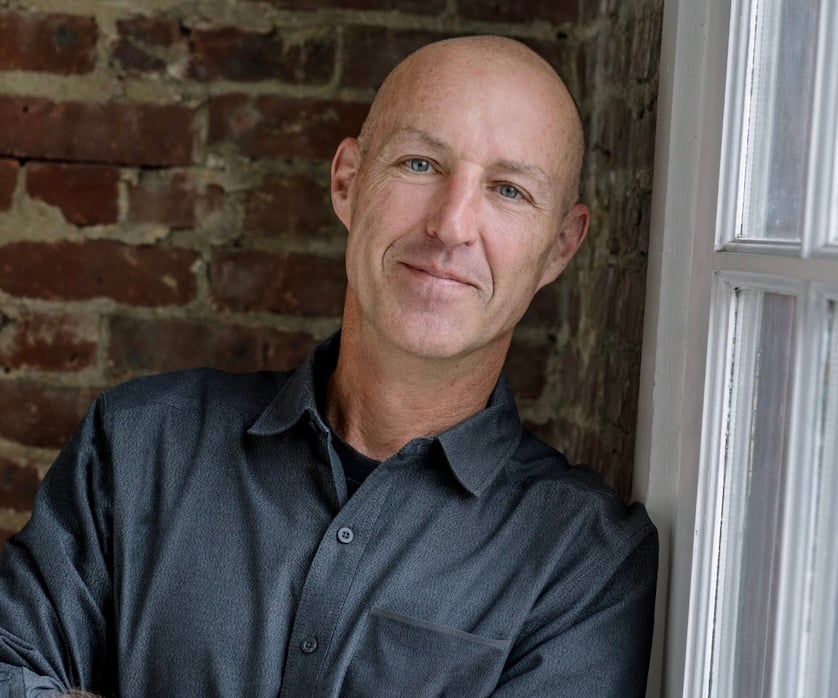
“It always surprises me when people come in, what they have to say about the work,” said gallery owner Michael Mazzeo.
Mazzeo, former owner of New York City gallery, opened Gallery Lucida at 18 Wallace Street with the hopes of bringing the national arts scene to a local gallery without patrons having to take a trip to the city.
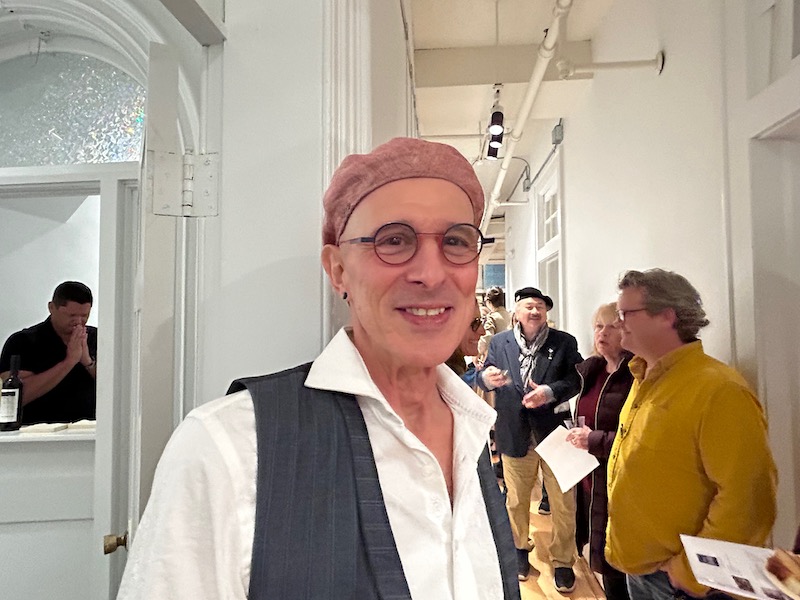
Gallery Lucida owner Michael Mazzeo.
However, the two exhibitions that opened the weekend before Thanksgiving to mark the gallery’s first anniversary have a more local focus, featuring the accessible yet complex work of two New Jersey artists, Scott Harbison and Stacey AS Pritchard. Both exhibitions meditate on the tension that exists between reality, imagination, and lived experience.
Drawn to the “distinct voice” in Harbison’s paintings and the subtle symbolism in Prichard’s sculptures, Mazzeo said it’s the sense of spontaneity that serves as the connecting link between the two.
In Scott Harbison’s exhibit, Creature Comforts, the dark forms in the paintings lurk on the canvas, almost illuminated by the flat planes of color that surround them. The color palette of the paintings is determined by the paint samples he picks up from Home Depot for 50 cents.
“Worry Warts” by Scott Harbison.
The composition starts organically with the body of Harbison’s creatures sketched out.There’s variety in the animal-like bodies that exist on Harbison’s canvases, but they bear a similarity in their large haunted, and dazed eyes that seem to stare back at the viewer.
“I pay a lot of attention to the look in their eyes,” said Harbison. I really want them to look a certain way, I think, but what they end up looking like often are creatures uncomfortable in their own paintings.”
Seeking to break from convention in his art, Harbison refers to himself as an “outsider artist.” From a young age, he was immersed in the punk rock scene. By age 15, he was opening for bands that would go on to become well known in prolific venues such as CBGB’S in New York. However, with the success of a music career in punk rock also came exposure to drugs. He started to take up painting during this period of his life, yielding the brush not to create art but as a quick way to earn money plastering and painting. His path to becoming an artist wouldn’t start until later in his life, when he became sober. His interest in painting was sparked by a gesture of spontaneity one night in his Newark apartment.
“I just walked by a piece of plywood and took some paint and did a face on it real quick. Without even thinking about it. One of my children said, “It’s pretty good,” said Harbinson.
Harbison posted the face on Instagram and was surprised to see later that night someone in India had liked the painting.
“I checked and his work was amazing. And that was like my biggest inspiration. I’m like, oh shit. He thinks this is good. I just started trying, and I never stopped.”
Stacey AS Pritchard’s art is also rooted in spontaneity. A mixed-media artist, Pritchard has a knack for visual storytelling, through the combination of two and three dimensional art materials. In her exhibition, Folk Tales From the Garden, the pieces that she creates are a unique blend of human, animal and natural forms inspired by nature, and mythology. They are also inspired in part by her own lived experience.
“Most of the forms and the animals and things like that, they’re all inspired by my backyard and my garden and mythology. I have a wonderful garden which is my sanity. It’s where I go for, for thinking, for meditation, for everything,” said Pritchard.
Her artistic process involves being attuned to the nature of the materials, as well as the conceptualized “character” that Prichard’s envisions embodied in the final sculpture. She envisions this character and the action that she seeks to capture, with special attention to how they might move. Some of Pritchard’s pieces are interactive and can be moved with a mechanism such as a crank in her work, Sun a Variation.
Skilled as a ceramicist, some of the forms in Pritchard’s art start in the kiln. 
“Bee Hive” by Stacy AS Pritchard.
“Once I get them back out of the kiln and I start putting them together, they start changing and shifting,” said Pritchard.
Other materials are found objects with distinct characteristics such as the dolls legs in “Page of Puppy Toes.”
Currently, Pritchard is collecting erector sets to use the small pieces in her sculptures.
Varying in subject matter, each of the pieces tells its own unique story, found in the intricate layering of imagination and reality, such as Pritchards paintings featuring what appears to be sea mines. At first glance the image of a sea mine is familiar even if the choice of subject matter is unexpected. The shape of the sea mines is similar to the shape of the images of the coronavirus pathogen. Similarly, Pritchard’s sculpture, Peace Dear Lily, a sculpture that depicts a hybrid between a human and a deer was created in response to the Israel–Hamas war as well as the war in Ukraine.
Reflecting on the first year of the gallery in Red Bank, Mazzeo hopes to continue to encourage Red Bank Residents to stop by the gallery, inspiring them to be curious about art that pushes the envelope.
“I love working with artists who are pushing boundaries,” said Mazzeo. “And that’s really why I think I end up showing work that is kind of challenging. Because I work with artists, you know. I’m drawn to their work. I’m fascinated by people who do things that I just can’t imagine doing.”
Do you value the news coverage provided by redbankgreen? Please become a financial supporter if you haven’t already. Click here to set your own level of monthly or annual contribution.