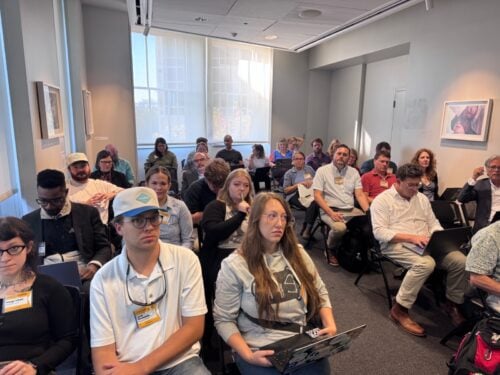
Superintendent Jared Rumage presents the Red Bank Borough Board of Education 2026-27 budget to the Board of Education on April 28, 2026. (Photo by Brian Donohue. Click to enlarge.)
By BRIAN DONOHUE
With a 6-2 vote, the Red Bank Borough Board of Education approved a 2026-2027 budget that requires taxpayers to pay 9.5 percent more to run the two district schools on Tuesday.
Under the $45.1 million spending plan, the owner of a home assessed at the borough average of $652,000 will pay an additional $408 a year to support the two borough schools.
In a presentation before the vote, Superintendent Jared Rumage cited the “astronomical jump” in employee health care costs as the biggest factor behind the tax hike.
He also described what he called an ongoing “triangle of challenges” facing the 1,138-student district, including repeated shortfalls in state education aid, a state cap on property taxes, and a “bifurcated system” created by the existence of the Red Bank Charter School
“Obviously, we are not ecstatic about the proposed tax levy increase,’ Rumage said.
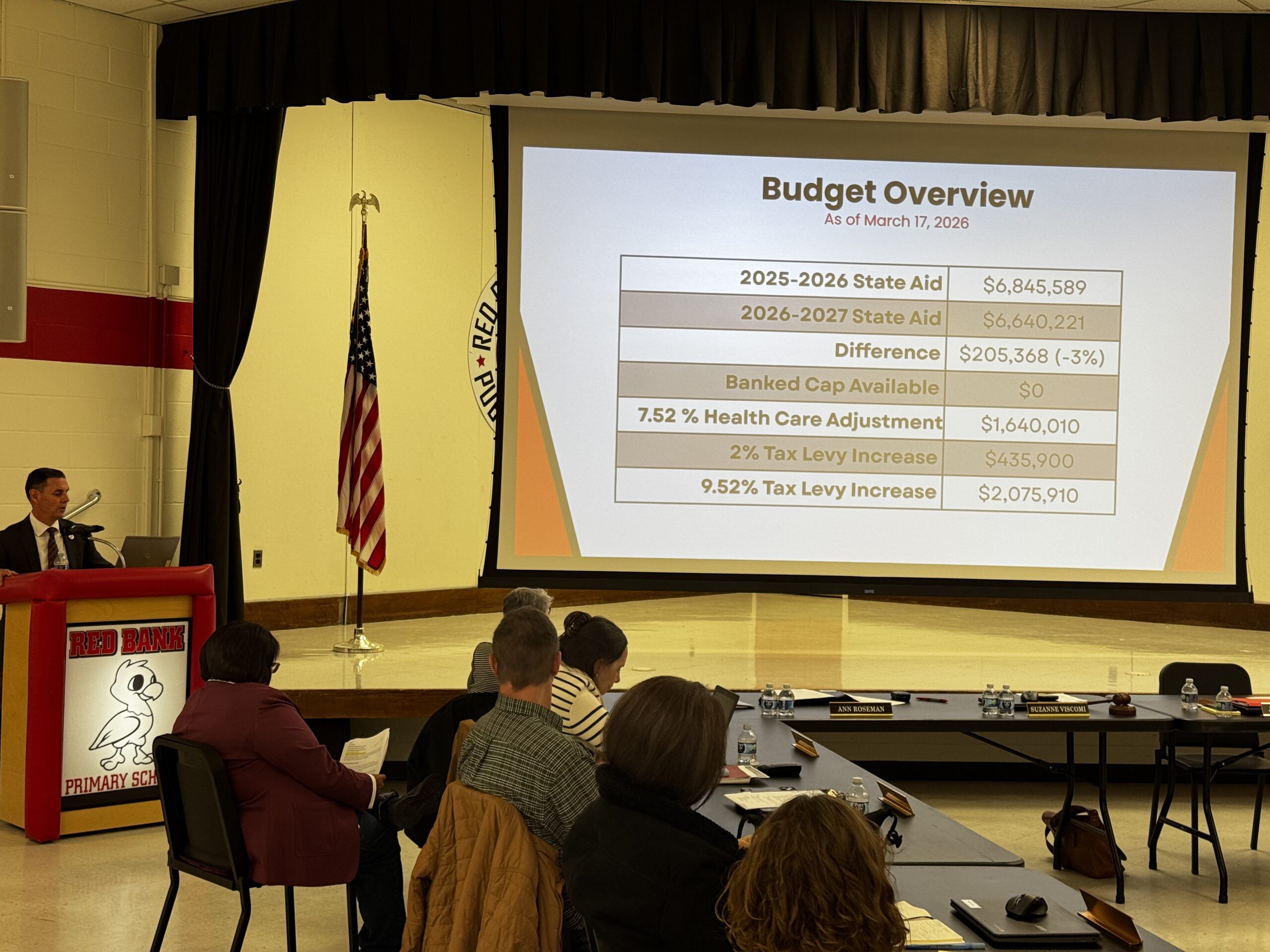
A chart presented by Superintendent Jared Rumage at the Board of Education budget hearing Tuesday night.(Photo by Brian Donohue)
The tax hike comes on the heels of a ten percent tax levy increase last year, which ended a multi-year run in which the board had kept hikes more closely in line, or below, the nationwide consumer price index. A half dozen members of the public attended the hearing.
Board member Jennifer Garcia, who voted against the budget resolution, said she had wanted to see presentations of what the budget would look like with a smaller tax levy hike.
“What I had hoped to see prior to this was a presentation of different scenarios at different levels,” Garcia said. “If we proposed five percent, seven percent, I really wanted to see that.”
She also said the board needs to more closely examine long-term cost drivers like transportation, energy, staffing and technology.
“We need longer-term solutions and a real deep dive into some of these big areas that are so costly,” she said.
She also called the budget a “call to action” for the community to “put our energy around a unified school district.”
The latter was a reference to the budget’s mandatory $2.8 million payment to the Red Bank Charter School, which district officials have for years called a financial albatross.
In response to a resident’s question, Rumage later said district estimates show absorbing the school’s 146 Red Bank resident students into the district schools could save taxpayers roughly $1.5 million a year.
Paired with a decline in enrollment, Board members’ and Rumage’s comments could portend what is expected to be a heated debate over the renewal of the Charter School’s charter, which the state Department of Education is scheduled to consider next year.
Board member Ellen P. McArthur, who cast the second “no” vote on the budget, cited what she called the “troubling” increase in district transportation costs year after year. She also called for deeper look at costs across the board.
“Our creative solutions are not there,” McArthur said. “Our transportation solutions are not there.”
“We seem to be in a paradigm which is basically ‘let’s just keep doing what we’re doing and saying ‘just drop a bigger check in my hand’ and that is unsatisfying to me,” McArthur said.
Both Rumage and several board members pushed back against calls to reduce or eliminate buses that take students to the Red Bank Primary School and Red Bank Middle School.
“We are maintaining our hazardous bus routes necessitated by the railroad tracks throughout town,” Rumage said in his budget presentation before the vote.
Both Board President Suzanne Viscomi and board member Dominic Kalorin said cutting bus routes was impossible until the borough was able to make streets safer for kids to walk or bike to school.
“I hear people say cut, just cut, let’s get rid of bussing,’ Viscomi said. “I wouldn’t want kids walking.”
Kalorin referred to the next-door Borough of Fair Haven, where he said streets are closed to traffic during the morning rush hour so kids can bike to school – a move that would likely cause an uproar in a town where traffic is a favorite social media gripe. “I’m 100 percent on board with that if we want to save money,” he said.
The budget raises the school tax levy (the total amount raised from local taxpayers) from 21.8 million to $23.9 million. Total per pupil classroom costs rose from $14,502 to $15,464.
Meanwhile, total revenues from state sources dropped from from 6.9 million to 6.7 million, after a drop from $8.1 million the previous year.
Board members who voted in favor of the budget echoed Rumage’s lament that the state funding formula and 30 percent increase in health care premiums put the district in a nearly unworkable financial situation.
“This tax formula is crazy,” Viscomi said.
The district is enrolled in the state health benefits plan, which the state treasury department has warned is in a “death spiral.” Under the budget, the district will pay $2.2 million more in premiums than last year.
The district has applied to the state for a special waiver that allows districts to raise taxes above the two percent cap to cover health care increases. Rumage emphasized that all other expenditure increases had remained within the two percent cap set by state law.
That was done in part by eliminating 11 positions through attrition, he said. Those include four teaching positions, three instructional assistants, three lunch aid positions and one maintenance position, Rumage said.
The board’s newest member, Christy Sunquist cast her vote in favor of adopting the budget and said reducing health care premiums and eliminating the charter school payments were the keys to addressing structural fiscal problems.
“Nothing moves the needle like charter and health care premiums,” Sunquist said. “Those are the two areas we need to run at. Nothing is going to move the needle like those two major areas.”
Rumage expressed hope that the crisis caused in districts across the state by the health care premiums might prompt the state legislature to finally act on resolving that issue, along with the school funding formula widely described as “broken.”
“There’s districts that cannot balance their budgets, they’re closing buildings,” Rumage said. “Everybody’s in crisis.”
Costs of running the two district schools represent 37 percent of a typical property owner’s bill, according to the Borough of Red Bank. Red Bank Regional High School represents another 24 percent. The municipal and county tax levies represent 25 percent and 12 percent, respectively.
The Borough Council has introduced a budget that would raise the municipal portion of the bill by eight percent.
The budget introduced by the Red Bank Regional High School Board of Education calls for a 2% increase in the tax levy. A public hearing and final vote on that budget is scheduled for 7:30 pm Wednesday, April 29 at the school, 101 Ridge Road, Little Silver.
redbankgreen editor Brian Donohue may be reached via email at [email protected] or by calling or texting 848-331-8331.
Remember: Nothing makes a Red Bank friend happier than to hear "I saw you on Red Bank Green!"
redbankgreen Classics
Partyline
“That should be on Red Bank Green!”
If you've ever thought that, join the 24 readers who've signed up to post their own stories on Red Bank Green.
Become a Guardian of the Green. Help redbankgreen stand for 100 years.
Help us get to our first 100 Guardians · joined byA Friend of the Greenand 6 others




 Superintendent Jared Rumage presents the Red Bank Borough Board of Education 2026-27 budget to the Board of Education on April 28, 2026. (Photo by Brian Donohue. Click to enlarge.)
 A chart presented by Superintendent Jared Rumage at the Board of Education budget hearing Tuesday night. (Photo by Brian Donohue)