Michael Paul Raspanti stands near a swallowtail butterfly in his family’s garden, one of about a dozen participating in the Patchwork for Wildlife program. (Photo by Brian Donohue. Click to enlarge.)
By BRIAN DONOHUE
This is going to be a happy feel-good story about flowers and butterflies, dear reader, but allow me to start it with a bitter personal grudge I’ve held against the Borough of Red Bank for 17 years.
In May 2008, my wife and I, already caring for our two-year-old child, welcomed the addition of a colicky newborn little sister. I was also starting a stressful new job requiring me to embarass myself live on camera every day. We were sleepless, overwhelmed, and you know, a bit freaking busy, to put it mildly.
So imagine my chagrin when I received a summons from code enforcement two weeks later for not mowing my lawn.
Yes, I’m still mad.
Patty Whyte stands in her garden which was granted a distinctive level certificate by the Candide’s Garden Patchwork for Wildlife program.(photo by Brian Donohue)
But fast-forward 15 years for a sign of how much things have changed. It is an actual sign congratulating us on the lawn mower-free existence we’ve adopted in the years since, and the shaggy, flower-filled mini-meadow it has created. Instead of a summons, we got an award, with the mayor’s name on it!
It’s part of an initiative called “Patchwork For Wildlife” which took root in Red Bank for the first time this summer. Created by Jon Gibbons, a retired NASA and Smithsonian architect whose “Candide’s Garden” in Lake Como stands as a model, the program aims to create swaths of eco-friendly meadows and habitat across towns, one yard at a time.
Property owners are coached on how to create wildlife-friendly yards using native plants, pollinators and eco-friendly methods. Basically, anything but the ecological dead zone known as a suburban lawn gets you points toward three levels of award certificates.
Spurred by Red Bank Animal Welfare Committee member Mary Warner, Red Bank this year joined Belmar, Lake Como and Point Pleasant in the program.
Across Red Bank, about a dozen property owners are participating. They’re your neighbors, free-thinking trailblazers who have ditched the bizarre perfect lawn aesthetic established by 18th-century English aristocrats and forced down our throats by producers of chemical, Navesink River-polluting, lawn care products in favor of something more beautiful and alive.
redbankgreen spent some time over the last lazy days of summer visiting the gardens of participants in the Patchwork for Wildlife program. Come along and smell the flowers.
Chris Schluter in her garden which contains more than 40 native plant species.(photo by Brian Donohue)
At 82, Chris Schluter stays spry partly by taking long walks in a weighted vest (five miles total the day we met her.) What she doesn’t do is mow the lawn.
“I don’t do anything now,” she said, pointing to the only remaining small patch of turf on her property on Bassett Place, which had not been mowed since June.
Since moving in three years ago, she has replaced all the front and most of the back yard grass with beds containing more than 40 native plants, including wild senna, native hibiscus, zizia, false turtlehead, beach plums, native snowberry, and serviceberry.
“This was all grass, and that doesn’t do anybody any good,” she said. “I’ve always loved bugs and snakes and frogs and stuff like that. And so I have to have native plants. That’s how I got into it.”
On our visit, the bumblebees were out in force working the tall yellow flowers of the wild senna. The scene was a wild buzzing panorama of color.
“They’re just so busy,” she said, letting out a chuckle.
As for pesticides or herbicides? Not in her yard.
“The bugs are fine here,” she said. “But if they go and land in somebody else’s yard, they’re doomed.”
As we chatted in the front yard, a tree-cutting crew was working in an adjacent yard. A random worker came over unsolicited and told her: “This is a beautiful garden.” Truth.
Patti Whyte trims the flowers in the yard where she has replaced the lawn with native wildflowers.(photo by Brian Donohue)
Patti Whyte takes a bit more laid-back approach to the Patchwork for Wildlife program and what she calls “my ramshackle yard.”
If it’s a native plant and it pops up, it stays. If it’s not native, well, it probably stays too. The approach has created extensive patches of coneflowers and milkweed with butterflies and bees flocking on our visit.
“I think it’s hilarious — we got an award for neglect,” she said, pointing to the yard sign granting her and her husband Jim a “distinctive level” of achievement for, among other features, a “greatly reduced lawn with clover.”
When they bought the place in 1995, the front and rear yards were all grass. Now it’s mostly flowers and other plants, predominantly native species. Those last remaining patches of grass are in her crosshairs, too.
“The whole idea behind a lawn is all wrong,” she said. “It’s based on the wealthy landowner myth, the lord of the castle, not to mention the amount of chemicals you need for a fake lawn.”
Jaime Maddalena releases a butterfly that had transformed from a caterpillar inside a protective enclosure in her yard.(photo by Brian Donohue)
Walking into the yard of Jaime Maddalena and Michael Paul Raspanti is like walking through a portal into some other realm.
Their Brown Place yard is a stunningly peaceful oasis, where winding gravel paths take a visitor past a chicken coop, flowerbeds bursting with native yellow partridge pea blooms, a firepit and a mini forest where beach plum and native paw paw trees spawn delicious fruit.
Paw paw fruit on a tree in the Brown Place yard of Jaime Maddalena and Michael Paul Raspanti. (photo by Brian Donohue)
It’s a medicine cabinet, where the family grows the herbs for salves and medicinal teas. It’s a classroom, where Jaime Maddalena runs a nature-based daycare. And it’s a pantry, where the ingredients for homemade elderberry honey and fresh eggs are harvested.
The family’s garden won the top prize in the Borough’s first annual garden tour in June.
When they moved in 13 years ago it was all grass and asphalt. Raspanti said the family created the garden partly as a reaction to the often troubling realities of the world outside it.
“There is so much shit going on in the world, and what can you do in the world?” he said. “Well, the best thing you can do is take care of your property.”
For more information on the Patchwork for Wildlife Red Bank program, click this link.
Also, Patchwork for Wildlife will be leading a tour of the Raspanti-Maddalena garden on September 20 at 10 am. Visitors are limited to 20 people. Visit the same link above for details on how to sign up.
redbankgreen editor Brian Donohue may be reached via email at [email protected] or by calling or texting 848-331-8331 or yelling his name loudly as he walks by. Do you value the news coverage provided byredbankgreen? Please become a financial supporter if you haven’t already. Click here to set your own level of monthly or annual contribution.




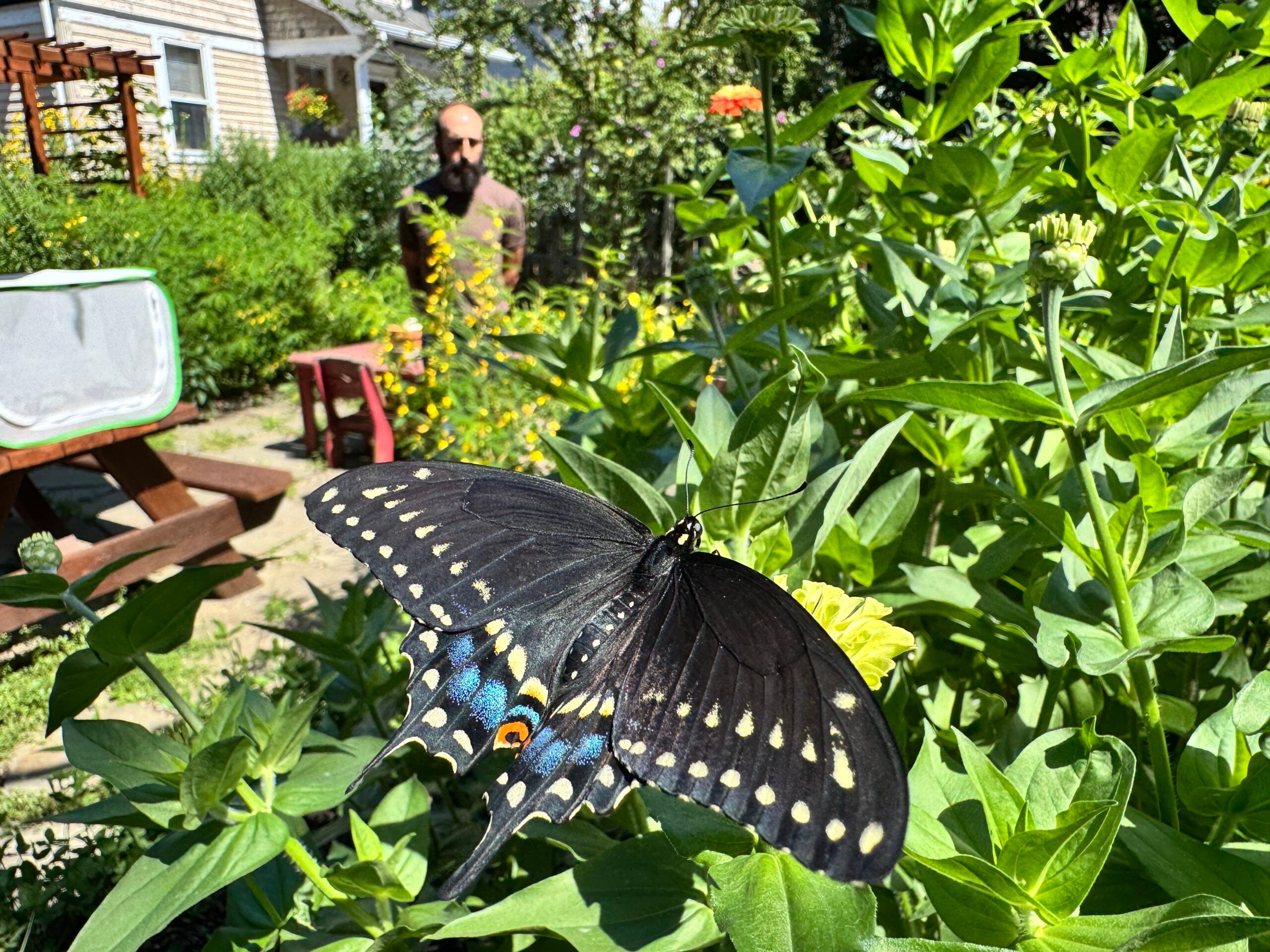 Michael Paul Raspanti stands near a swallowtail butterfly in his family’s garden, one of about a dozen participating in the Patchwork for Wildlife program. (Photo by Brian Donohue. Click to enlarge.)
 Chris Schluter in her garden which contains more than 40 native plant species. (photo by Brian Donohue)