



The untold story of a Red Bank coffeehouse that helped shape Bruce Springsteen, and other teens, in 1968.
 Bruce Springsteen, above left, performing with the Castiles at the Off Broad Street Coffee House in 1968. Below, Springsteen with fans outside the Count Basie Theatre in 2008. (Above photo used with permission of Eric Rudolph. Photo below by John T. Ward. Click to enlarge)
By JOHN T. WARD
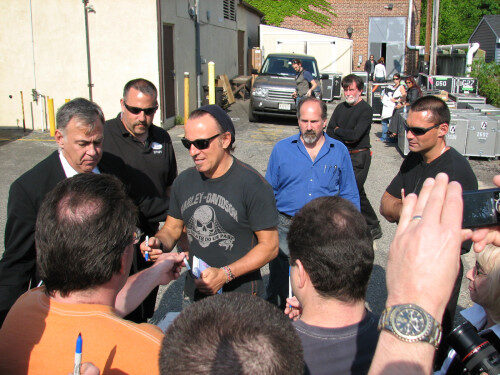 Talk about a homecoming: When Bruce Springsteen joins the E Street Band to close out the Sea Hear Now Festival on the beach in Asbury Park Sunday night, he’ll be greeted by some 35,000 fans, the largest audience he’s ever entertained in the city that’s engraved in lore as his launchpad to fame.
But it’s worth noting that by the time he first strummed a chord at Asbury’s Upstage club – and long before the advent of the Stone Pony – teenaged Springsteen was four years into an intense musical apprenticeship that took him to dozens of high school gyms, pizzerias, beach clubs, roller rinks and other unheralded venues around Monmouth County.
For one stretch in 1968, that included a pivotal residency of sorts in Red Bank, with the future Boss fronting two rock bands and, possibly for the first time, performing his own songs solo.
Fifty-six years later, the gathering place known as the Off Broad Coffee House is long gone and little known. Even the most devoted site-hunting fans may never get it on their radar.
But the place, and that moment in time, are embedded in the memories of those who hung out there and crossed paths with Springsteen. Among them were a pair of teen folk singers who met at the coffeehouse, got married and remain together today; a future music magazine photographer who took his first rock photo there; a seminary graduate who made it his mission to lend an ear; and a future Rumson restaurateur.
Here’s the never-before-told story of the Off Broad, and some fans who knew Bruce when.
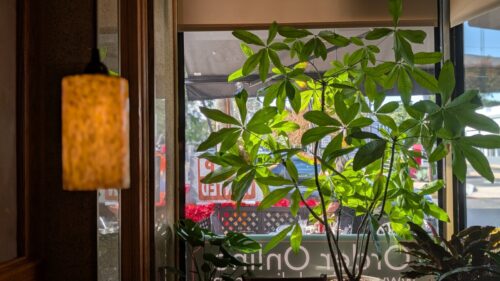
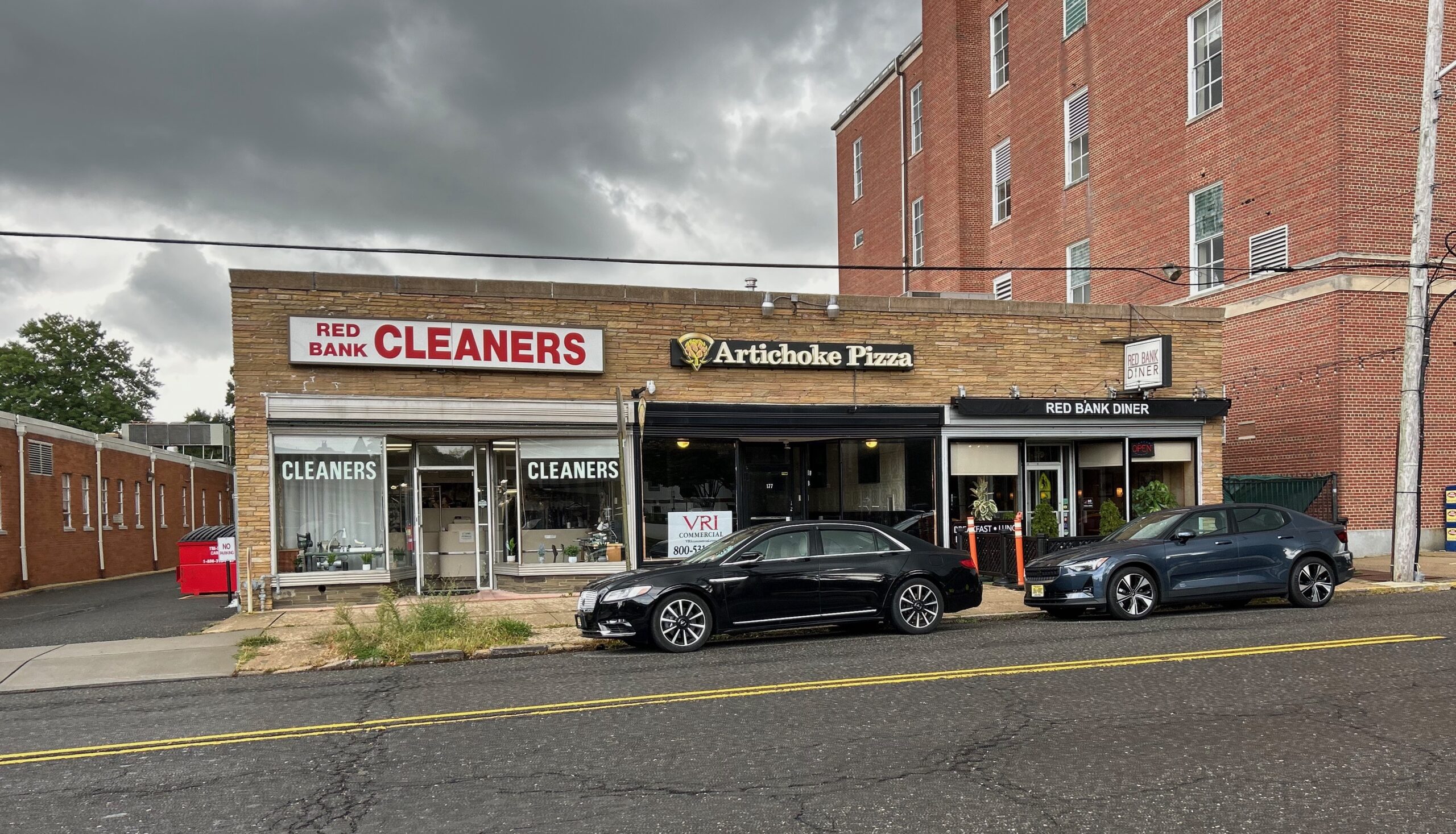 The space that housed the coffee house is now home to the Red Bank Diner, at right. (Photo by John T. Ward. Click to enlarge.)
The Off Broad Street Coffee House popped up, on Broad, in May, 1968, at the southern edge of downtown in a building flanked by the Post Office and a four-story New Jersey Bell Telephone (now Verizon) switching facility.
America was a cauldron at the time. Martin Luther King Jr. had been assassinated just weeks earlier, sparking riots in numerous cities, and just weeks later, presidential candidate Robert F. Kennedy also would be murdered. Unrest over the Vietnam war paralyzed college campuses.
Amid the rising tension, and after “an extensive survey of teenagers by teenagers,” the leaders of the Community YMCA in Red Bank decided to set aside a space for young adults, according to the organization’s 1967 annual report.
But where? The Y itself was between addresses. Its facilities at 40 Riverside Avenue – now the site of the Atrium at Navesink Harbor – had been demolished two years earlier; the replacement health center on Maple Avenue was still under construction and would not open for another two years.
Y officials had some “trouble finding a home” for the planned coffeehouse, the Red Bank Register reported, but settled on a storefront at 179 Broad Street (misidentified by the newspaper as 169 Broad).
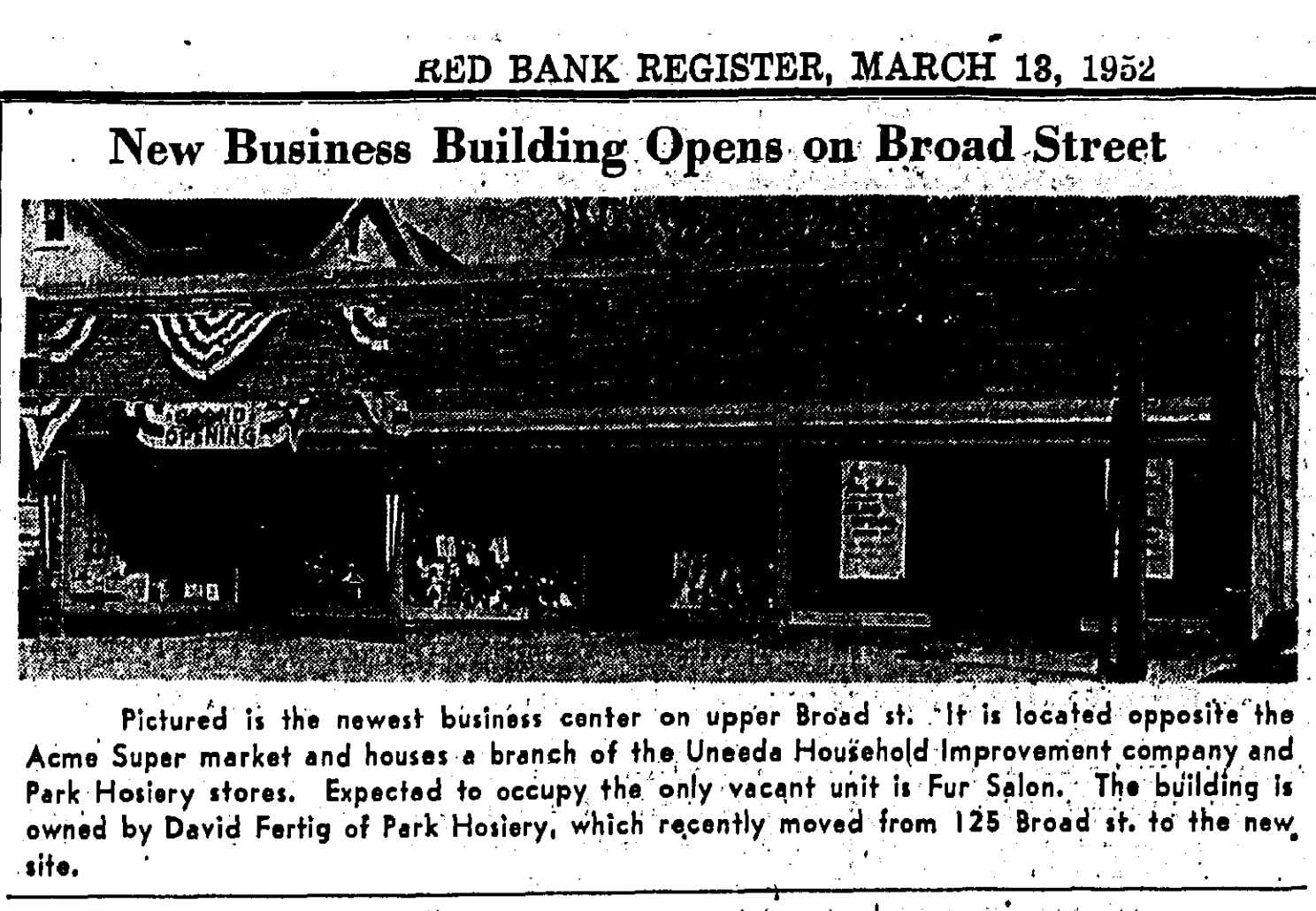 A 1952 Register photo of the building that would later include the Off Broad. (Click to enlarge.)
The single-story building had been erected on the site of William A. Pintard’s lifelong home. Pintard, a recently appointed member of the borough zoning board, was one of 85 people – including eight from Red Bank – killed in a commuter train crash in Woodbridge on February 6, 1951, then the worst such tragedy in New Jersey history. His funeral was held in the enclosed front porch, the Register reported.
Just 13 months later, the house was gone, and merchant David Fertig completed construction on the boxy new structure, which he divided into three long, narrow retail spaces of 1,900 square feet apiece. He moved his Park Hosiery shop (featuring “performance-tested panties,” among other offerings) from a block away to the middle of the three, at 177 Broad Street. The space at 175 Broad, to the north, was rented by Uneeda Home Improvement before Rainbow Television and Hardware took over in 1954, beginning a run that lasted into the 1980s.
The one at 179 Broad was first home to a fur salon; then a men’s and women’s clothing shop called Barda; and later a store for a medical supply company. It became an office furniture store in 1970, a restaurant in 1977, and now houses the Red Bank Diner.
But for several years in the late 1960s, 179 Broad sat vacant, according to records in the Register and Polk’s City Directories. The Y signed a lease in late April, 1968, and within days, teen volunteers from a church group set out to turn it into a coffeehouse.
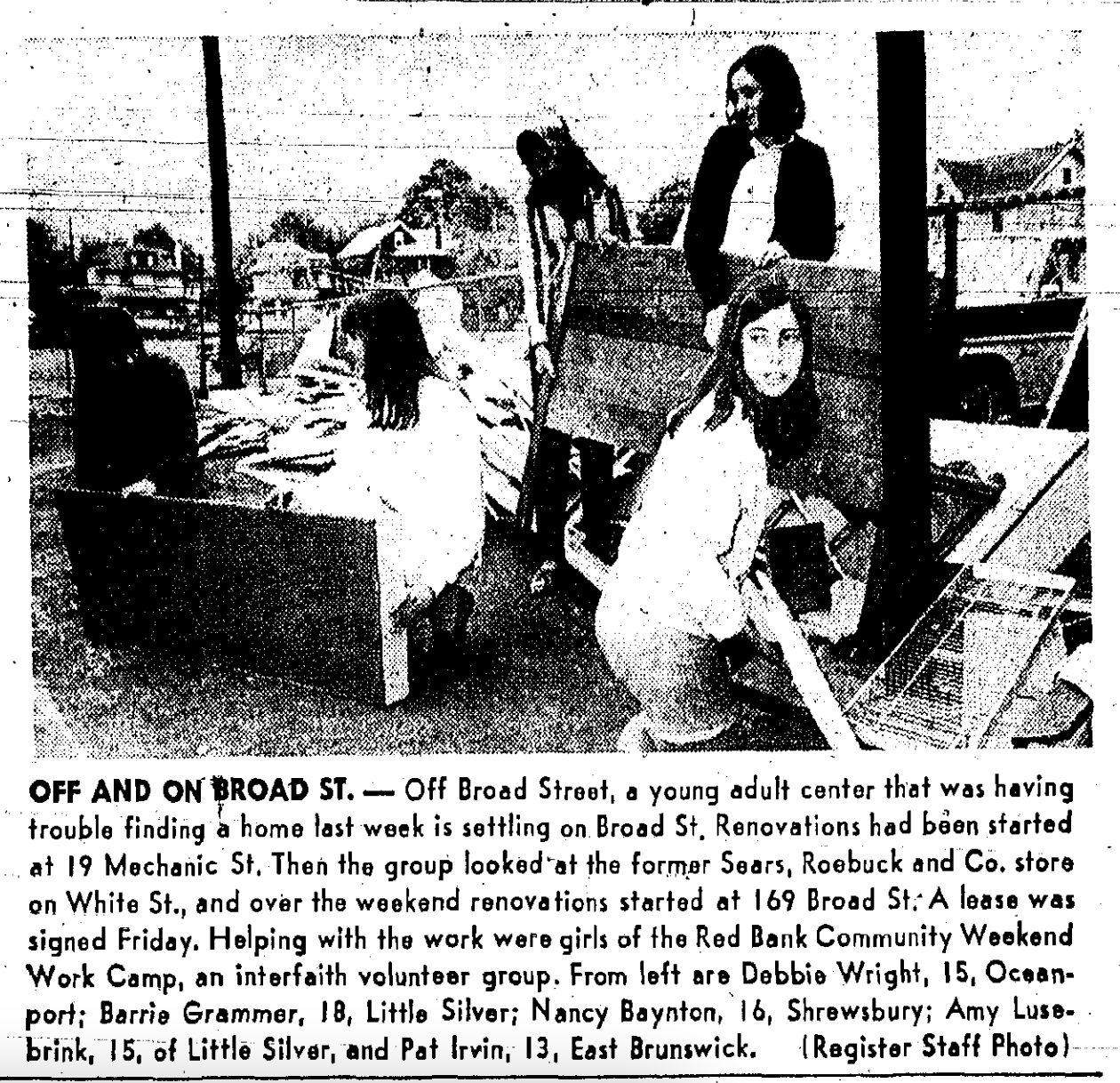 The Register reported plans for the Off Broad in its May 1, 1968 edition. (Click to enlarge.)
An elevated stage was installed just to the right of the entrance, with a few rows of tiered seating to the left and tables along the walls. Artists whose names are lost to history painted a backdrop for the stage: a mural featuring comical faces and the name of the place in balloon-style freehand typical of the era.
Instrumental in pulling it all together was Elizabeth “Libby” Scudder, a wealthy Locust resident affiliated with the Y. But her contribution, too, appears to have been lost to the passing years, preserved in the memory of Todd Sherman, who worked there as a 16-year-old.
Scudder, who died in 2004, believed the coffeehouse could provide “a safe place,” a refuge from drugs and violence for people just coming of age, Sherman told redbankgreen. “And it really was,” he said.
Venues featuring live folk music were beginning to dot the county map. Among them was one just down the road, at Fort Monmouth, open to civilians as well as military personnel, and another called the Left Foot had opened less than a year prior in a church in Freehold. Long Branch had the Inkwell. And across the Navesink in Middletown, Dr. Dick Levine, a dentist, and his wife, Marlene, organized weekly folk circles in the basement at town hall.
Teen-only dance clubs were also thriving. Monmouth County had three “Hullablaoo” franchises. In New Shrewsbury (now Tinton Falls), in a converted carriage house on the southwest corner of Shrewsbury and Sycamore avenues, was a members-only club called Le Teendezvous that opened in 1965 and drew throngs of kids on Friday and Saturday nights.
But “this was unique,” Sherman said of the Off Broad. “There was nothing like it.” When it opened on May 11, it immediately began drawing musicians and audiences of teens and young adults to hear folk, blues and rock in an alcohol-free setting.
A feature story in the Register that summer called it a place for young people “to meet, a place to hear their kind of music; a place to feel free, and to discuss without inhibition the deep questions of our time.”
From 7 p.m. to 1 a.m. weekdays, and for 12 hours a day on weekends, patrons would “sip 10 varieties of coffee and 14 kinds of tea, or feeling continental, try one of eight different Italian soft drinks,” according to Register reporter Bob Bramley. Dick Levine would introduce the performers as they took to the elevated stage.
“Accompanying themselves on guitars, banjos, autoharps, mandolins, they sing folk songs with varying degrees of competence,” the paper reported. “There are a few comedy songs — often blackly comic — but most are laments in minor keys apparently written by lonely individuals in fairly dire straits. The music tells of the ills of the world, not its wonders.”
For the most part, the talent consisted of local folk and blues singers, many in high school and college, some from the fort, with rock bands mixed in.
To get a slot, acts “had to have some reputation,” Sherman said. In fact, one night, future Rock Hall of Fame member Roger McGuinn, already famous for his work with the Byrds, turned up. “I don’t know who got him or how, but he showed up and played,” Sherman said. Unknown players would have to pass the weekly open-mic audition.
Jack Fitterer was a 16-year-old student at what was then Middletown High School and regular performer at both the Fort Monmouth coffeehouse and the Levine’s folk circles. He, too, played from the stage at the Off Broad.
“It was a great time to have a guitar and to want to sing,” he said, and at the Off Broad, “the entry bar was pretty low. For open mic night, anybody could walk in. And then if they liked you, they would give you an official slot.”
Also among those who became regulars were the the Bluegrass Ramblers, with Dave Griffiths, Red Bank High School class of 1967, on banjo, guitar and two other instruments. “It was nice that there was a permanent spot that people could go play,” he said.
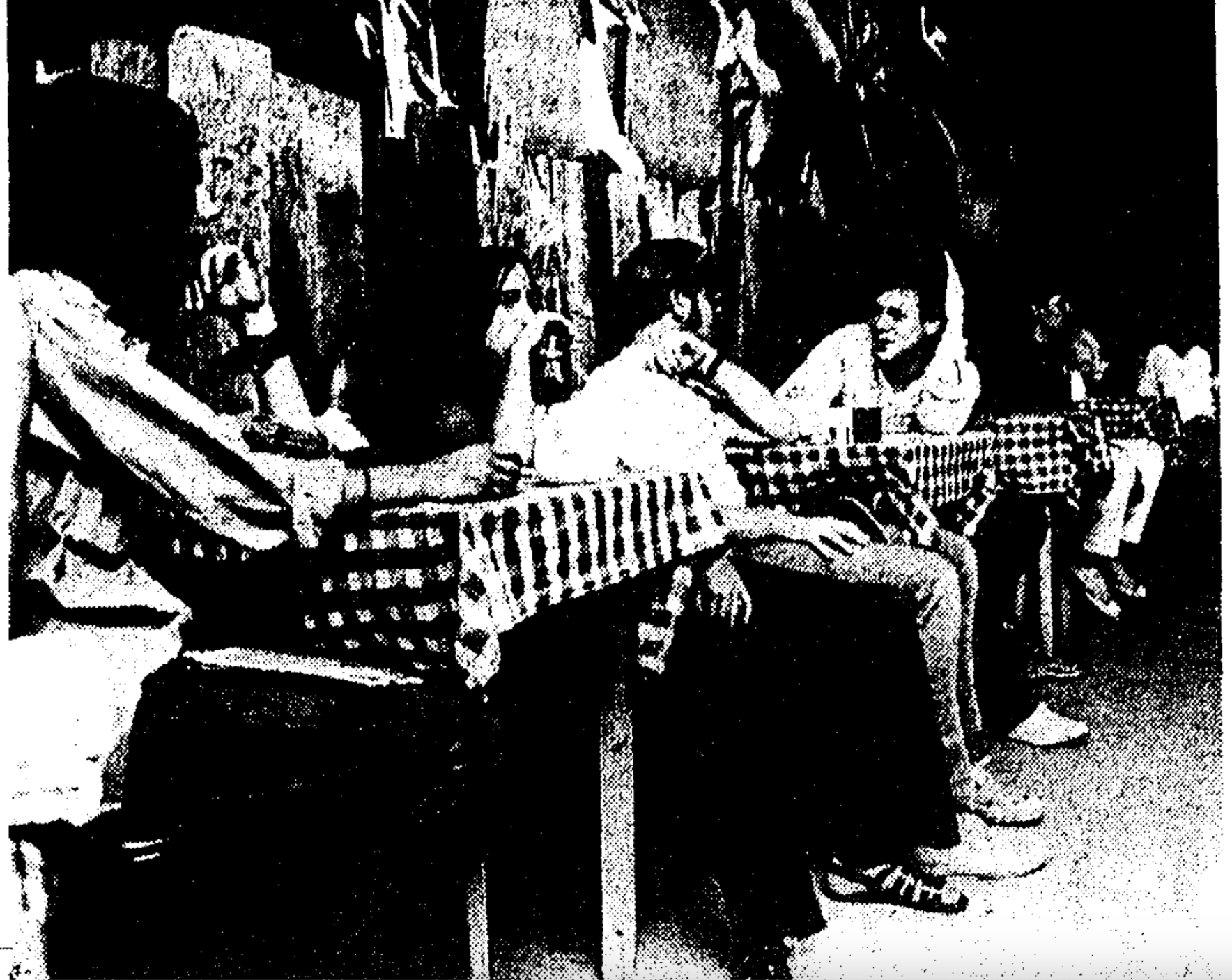 Patrons of the Off Broad as seen in the August 28, 1968 edition of the Red Bank Register. (Click to enlarge.)
Another was a five-piece blues rock band, Something Blue. Sherman, a resident of New Shrewsbury and student at Monmouth Regional High, played guitar in the band. He liked the Off Broad so much he took a paying job there.
He was, in effect, the assistant manager, a role that included making sure the kitchen was stocked with coffee and sandwich fixings, helping to set up the stage, and playing records over the club’s stereo system: Bob Dylan, Paul Butterfield, the Vanilla Fudge and other hot bands.
Seated at a window that separated the kitchen from the clientele, Sherman would spin records from his own collection and keep an eye on the activity, as well as on the front door. He ended every night with “Flute Thing” by the Blues Project “because it was such a cool song.”
Sherman was at the Off Broad every day after school, until his grades started to slip, at which point his parents demanded he get back on track as a condition of returning. He did. He just had to be there.
“All your friends were here. You’d meet girls here. It was ‘meet you at the coffeehouse, see you at the coffeehouse,’” he said. This was the place to be.”
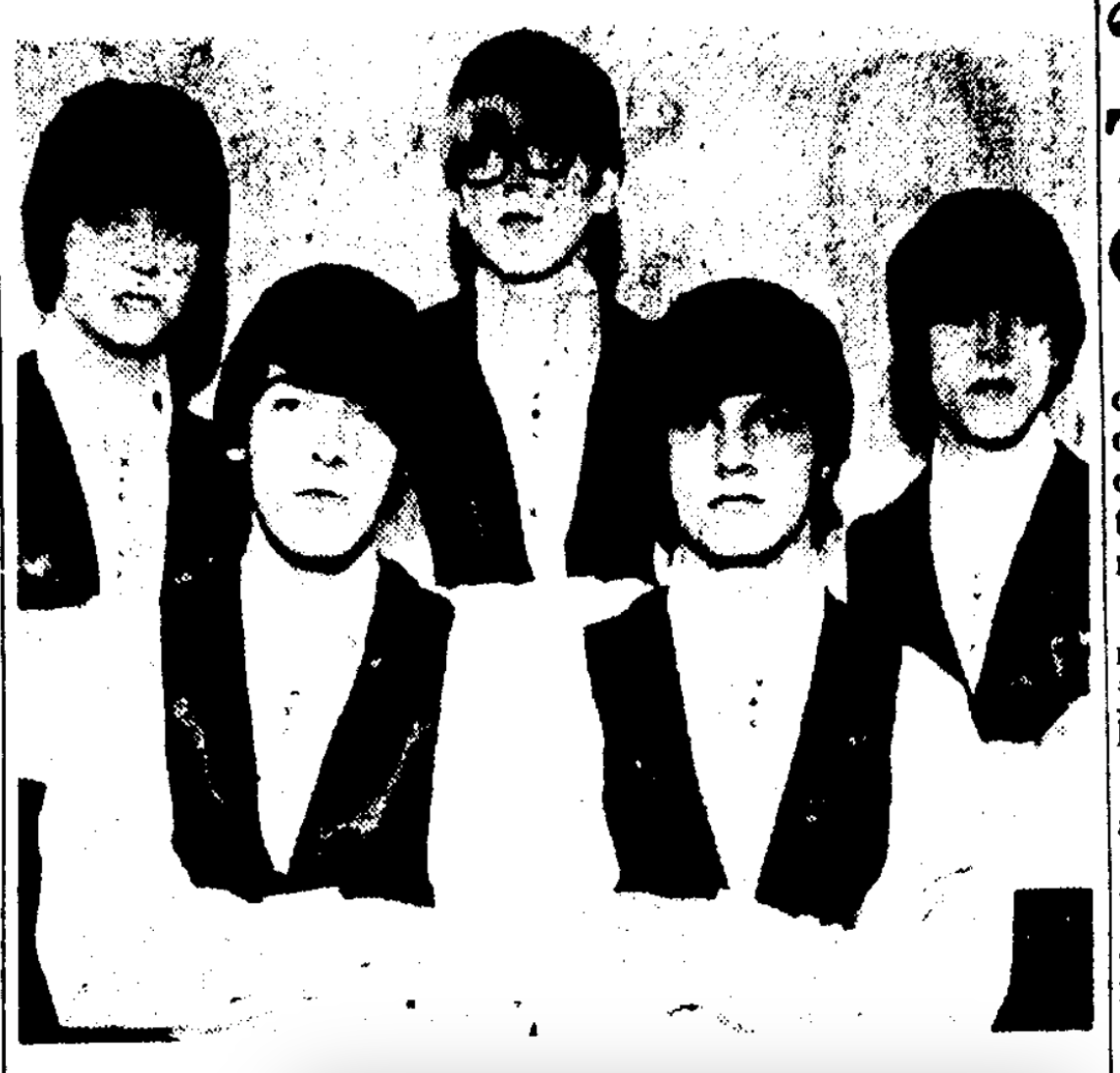 A 1966 promo photo of the Castiles, with Bruce Springsteen second from left, that ran in the Register. (Click to enlarge.)
Also finding their way to the stage were the Castiles, one of whose members was Bruce Springsteen. Then 18 years old, Springsteen was wrapping up his second semester (of three) at Ocean County College and crashing occasionally in the basement of the house across the street from Sherman’s on Glenwood Drive, where Something Blue practiced.
Named for a shampoo brand and comprised primarily of students from Freehold Regional High, the Castiles had formed in 1965, and were amazingly busy. By the spring of 1968, they had already played dozens of gigs at numerous venues, including Le Teendezvous and other teen dance clubs. According to the exhaustive gig wiki Brucebase, the band’s first known performance in Red Bank was for a dance at Red Bank Catholic High School in September, 1966.
Taff Mace was a student at Freehold Regional when Springsteen was also a student, and saw him play with the Castiles, though she did not know him.
“Every dance I went to in high school that was a decent one was his band, the Castiles,” she said. And as the band’s lead guitarist and sometime singer, Springsteen already had a reputation as an outstanding performer. But while his star power was evident, and he had flocks of admirers wherever he played, Springsteen “was about the music,” said Taff. “I don’t think he ever saw himself as a big guy at all.”
Soon after the Off Broad opened, the Castiles started playing there, belting out covers of Cream, the Rolling Stones, Jim Hendrix and some of their own tunes co-written by Springsteen and singer George Theiss.
“Good old serious rock and roll,” said Sherman.
“One of the things that I remember was that the place had typical storefront plate-glass windows, and those things would vibrate and act like loudspeakers” when the Castiles were on, O. French Ball told redbankgreen. “You could hear it all the way down the block when Bruce was playing. It was really loud.”
Ball, of Lincroft, was a 26-year-old recent seminary graduate who’d started working as a minister of education with the First Baptist Church on Maple Avenue.
“I was a strong believer that the church ought to be more than just a building,” he said. “So I looked for ways to be involved in the community – particularly with young people. This led me, among other places, to Off Broad Street.”
With longish hair and “dressed like a hippie,” and to the consternation of some congregation members, Ball volunteered at the coffeehouse, with no particular role in mind other than to be a sounding board.
“I figured, well, you know, I’m a pastor in the area, so I should show up and be available if kids need somebody to talk to.”
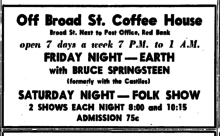
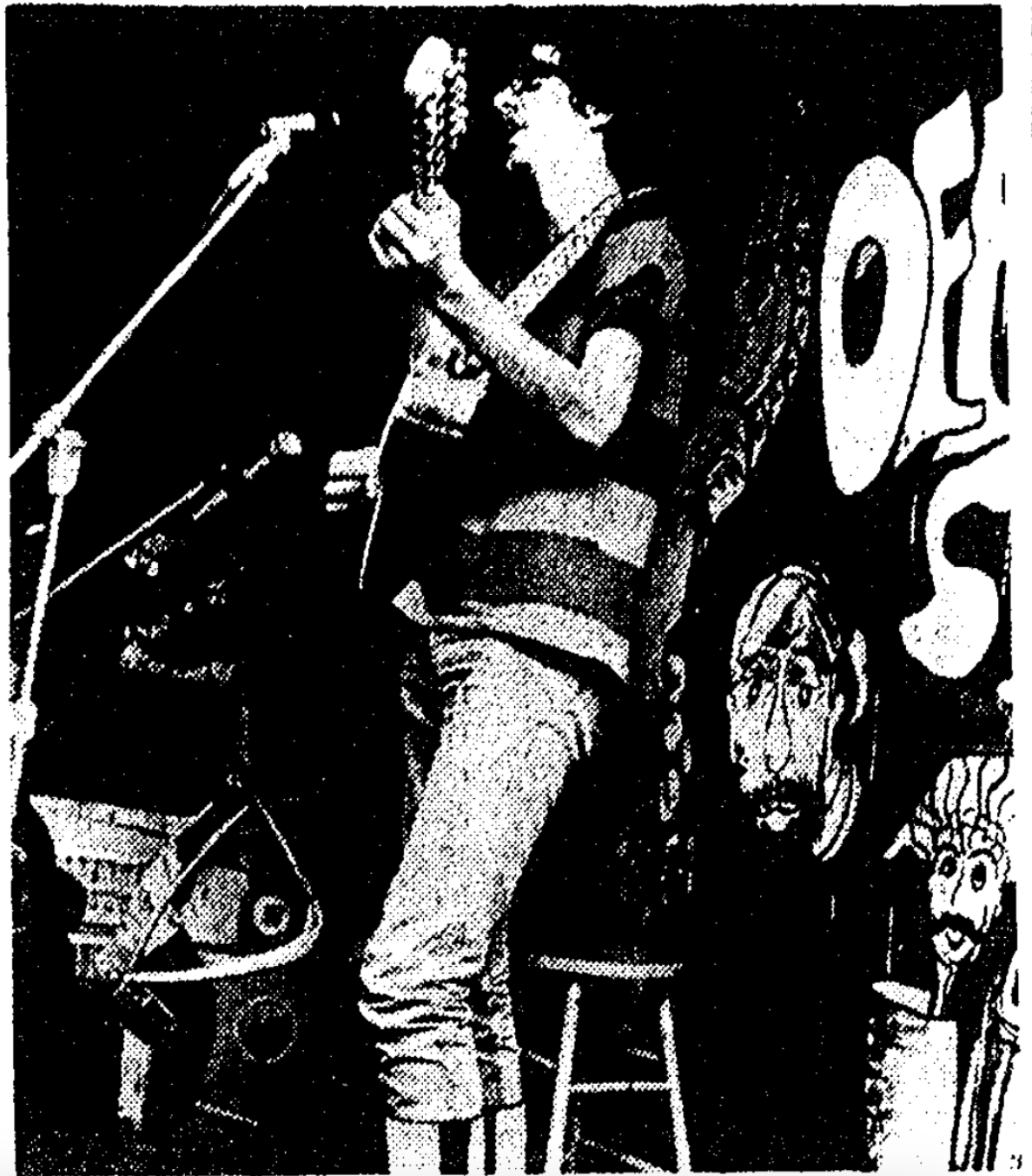 Jack Fitterer onstage at the Off Broad as seen in the August 28, 1968 edition of the Red Bank Register. Below, an August 16, 1968 ad touting Springsteen’s new power trio, Earth. (Click to enlarge.)
 On the afternoon of Saturday, June 22, 1968, Eric Rudolph visited the Off Broad for the first, and only, time. He was 15 years old, also a student at Middletown High. Onstage, the Castiles were ripping through the Chambers Brothers’ psychedelic “Time Has Come Today,” with someone banging on a pot to simulate the song’s ticking clock sound.
He’d heard of Springsteen, but had not seen him play, Rudolph told redbankgreen. But “even then, the first time I saw him, I could tell he was not the average rock musician,” Rudolph said. “I thought, ‘well, this has a little more energy than I would expect from somebody from around here.”
Rudolph was carrying his Mamiya/Sekor 1000TL camera with him, as he often did. He wanted to be a rock photographer, he said, “but I didn’t have a telephoto lens, and could never get close enough” to capture a performer. This time, however, “I was sitting right there, the first time I was ever close enough to get somebody rocking out.”
He raised his camera and snapped a shot of Springsteen in front of the mural – hair in his face, his prognathous jaw looking like a ship’s prow, his guitar a weapon. (No, not that guitar.)
“Too bad it wasn’t anybody famous,” Rudolph quipped.
For the first three months of the club’s existence, the Castiles continued to play the Off Broad and elsewhere. But when he wasn’t onstage with the band, Springsteen would play solo at the Off Broad, something he appears not to have done much before, going by gig descriptions in Brucebase and other sources.
With just a piece of string used in lieu of a strap on his acoustic guitar, “he would come in off the street, just walk up onto the stage and play for hours,” said Sherman. The audience, he said, would be “mesmerized,” by his already powerful voice, his intricate guitar work and his overall showmanship.
“Even back then, he was great,” he said.
He would also play more of his own songs, marbled in among covers. Springsteen had been writing songs ever since he joined the Castiles. But by early 1968, Springsteen wrote in his 2016 memoir, “Born to Run,” he’d turned his attention to writing “some acoustic music” on a 12-string guitar, “penning some prog-style, Donovan-and-Dylan-influenced originals that I’d end up singing in the local coffeehouses when I wasn’t thundering through the blues.” (The Off Broad is not mentioned by name in the book.)
“Deep in the thrall of singer-songwriters Tim Buckley and Leonard Cohen, Bruce had spent the winter filling notebooks with his poems,” Peter Ames Carlin wrote in his 2012 biography, “Bruce.” “Heading into the spring with a new repertoire of acoustic songs, he had played a few solo shows at the Off Broad Street Coffee House in Red Bank, and felt an entirely new charge standing alone with only his guitar, voice, and innermost thoughts to offer.”
The lyrics of 15 of those songs are among the thousands of artifacts at Monmouth University’s Bruce Springsteen Collection, evidence of his early “growth curve” as a writer and “ambitious exploring of his own sympathies and passions,” its website says.
Bob Santelli was a high school junior and folk musician when he went to the Off Broad one night with some buddies to check out some acoustic music. He’d recently moved to Point Pleasant Beach from West New York, and simply couldn’t fathom that everyone in his new hometown wasn’t talking about the singer-songwriter Tim Buckley.
“I walk into the coffeehouse, and there’s some guy playing Tim Buckley,” Santelli said. “I couldn’t believe it.”
And the quality? “I was knocked out by it,” Santelli said. “I remember going up to Bruce afterward and saying, ‘man that was great.'”
“From the very beginning, he had a certain star quality about him, so to speak,” said Jack Fitterer, who sometimes shared the stage with Springsteen and was dazzled by his guitar skills. “He was the big guy in town.”
French Ball, who was also a folk singer, said Springsteen followed him onstage one afternoon. “I still had my guitar out when he started playing, so I sort of played along with him,” he recalled. “He was playing ‘Season of the Witch.’ And that really stands out in my memory. He put a spin on it like Donovan would have never done, but it was really good, very impressive.”
At the same time, the Castiles were fraying, and even bickering onstage. In his book, Carlin reports that “at one mid-July show at the Off Broad Street, a fan took a picture that captured a pissed-off looking Bruce hoisting his middle finger” at George Theiss. (redbankgreen was unable to locate the photo.)
In early August, three members of the band got swept up in a drug raid, and the Castiles were abruptly kaput. Springsteen – who was vehemently anti-drug – quickly teamed up with bassist John Graham and drummer Mike Burke from Something Blue to form Earth, a blues-rock trio, sometimes joined by a keyboardist.
“From the beginning we wowed the locals,” Springsteen wrote in his memoir. “For this new sound we were the only game in town. We had the look, with my Italian Afro and [Burke’s and Graham’s] hair down to their shoulders; the ferocity; and a repertoire of modern blues standards popularized by Clapton, Hendrix, Beck and the like. I took flight as a guitarist; the night was an endless series of long, slashing solos on my miracle Gibson. We were the monster rock kings of our piece of the Shore.”
“The three of them playing the Cream set was outstanding,” said Taff Mace, recalling in particular Earth’s version of “Crossroads” and “a long take on ‘Born Under A Bad Sign.’ It was just amazing. I was a kid, so I won’t listen to it now with these ears, but to my young ears, it was pretty exciting.”
According to Brucebase, Earth made its debut at the Off Broad on August 16, though Carlin wrote that the band filled what was to be a Castiles booking at Le Teendezvous six days earlier. In any event, the Boss was clearly leaving his high school roots behind and moving into a new phase in his development.
He even had promoters: two kids who billed themselves as “Ooze and Oz” who would keep an eye on the door to make sure Bruce and the band got their piece of the 75-cent entry fee, Sherman said. An ad in the Register for the Red Bank shows touted “EARTH with BRUCE SPRINGSTEEN, formerly with the Castiles.”
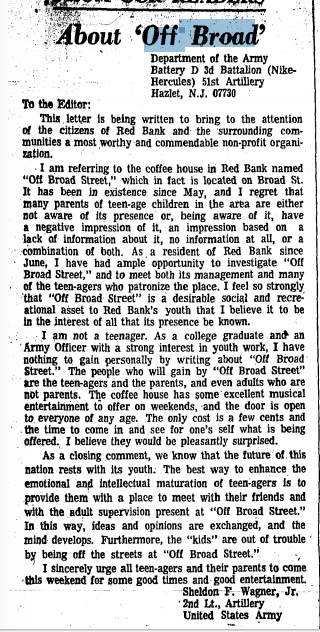 In November, 1968, the Register published a letter to the editor by Army officer Sheldon F. Wagner Jr., who had recently moved to Red Bank, in which he lauded the Off Broad as “a desirable social and recreational asset” to the town’s youth, offering “some excellent musical entertainment.”
Despite such sentiments, the Y’s extension director, John Mitchell, went begging that month to the recreation commissions of nearby towns, as well as churches and other organizations, seeking help with the estimated $19,000 annual cost of running the coffeehouse. After all, the kids from those towns were using the place, he argued. At the same time, Mitchell said, attendance wasn’t strong enough to merit keeping it open all week, which was down to Friday and Saturday nights only.
“Our problems have been many, some justified and others not,” Mitchell wrote in a proposal, according to a report in the Register. “First, the place attracted a good number of hippies, along with its more conforming type clientele. This produced rumors of narcotics. This rumor was proven false when the State Police studied the place over a six weeks [sic] period. However, attendance from the wide spectrum of teenagers did not come up to expectations.”
On the question of drugs, everyone interviewed for this article agreed: they were not an issue at the Off Broad.
“There’s no there there,” said Victor Filepp, then a Colts Neck 18-year-old who ran the light board at the coffeehouse. “It wasn’t that kind of a place.”
To boost attendance, the Y proposed supplementing the “strictly psychedelic activities” of Friday and Saturday nights with daytime offerings intended to attract younger teens, church groups and even seniors, the Register reported.
But the plans and pleas failed to turn things around. After the club had been open about eight months, “the funding dried up,” Sherman said. “Libby Scudder came to us and said that she was sorry, but it’s not working out” and the Off Broad would have to close.
“We were all devastated,” he said. “This was our hangout.”
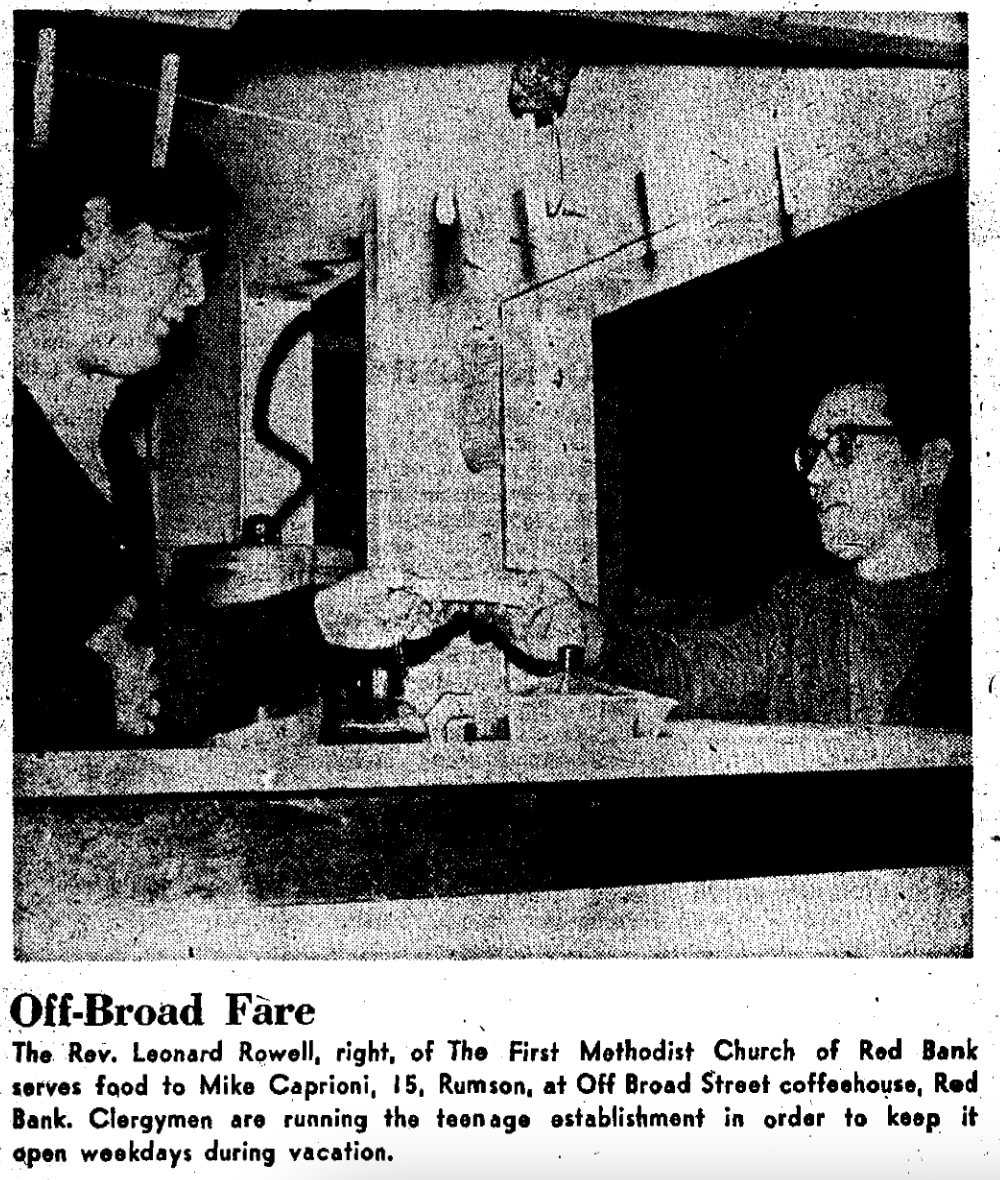 Local clergy staffed the Off Broad over the Christmas Break in 1968, the Register reported. (Click to enlarge.)
The Register appears not to have reported the Off Broad’s demise. The coffeehouse was listed in the 1969 Polk’s City Directory, but the YMCA’s 95th annual report, published in the Register in May of that year, made no mention of it.
Springsteen and Earth had played their final two Off Broad shows on December 20, 1968. All told, Springsteen gave at least 16 performances in the room by the end of the year, often for two seatings in a day, according to Brucebase.
Two months later, Earth was also over, and Springsteen had made his way to the Upstage, a third-floor, all-night club above a shoe store in downtown Asbury Park, to show off his guitar chops. Brucebase lists no more Springsteen appearances anywhere in Red Bank until April, 1972, when the Bruce Springsteen Band – including future E Street Band member Steve Van Zandt – performed at Red Bank Catholic.
 Bruce Springsteen arriving for tour rehearsal at the Vogel in Red Bank on January 13, 2023. (Photo by John T. Ward. Click to enlarge)
Springsteen would go on, you may have heard, to megastardom: millions of concert tickets and records sold, his face and sound known around the globe. (A documentary about his current world tour, including footage of rehearsals at the Vogel theater in Red Bank, is scheduled to air on Hulu and Disney in October.)
The diner that occupies the Off Broad space now has wall panels that conceal any evidence that may remain of the coffeehouse. Once an occasional customer, Springsteen hasn’t been seen at the diner in years, and the business doesn’t draw curious fans, owner Billy Avgoustis told redbankgreen.
Stan Goldstein, who runs tours of Springsteen haunts with Asbury Park Press reporter Jean Mikle, said the Off Broad has never been on the itinerary – but may be added after this story sees the light of day.
“It’s really one of the lost places of Bruce’s career,” Goldstein said. “Everyone knows the Upstage, the Le Teendezvous a little bit, and of course the Stone Pony. But this sort of gets lost a bit. It’s a little-talked-about place that was a big part of Bruce Springsteen’s career.”
Video: Todd Sherman visits the Red Bank Diner and recounts its days as the Off Broad coffee house. (video by Brian Donohue.)
For the Off Broad’s devotees, life led down other paths, and the place and time have resonated across the ensuing decades, they said.
“One quiet Sunday night” in August, 1968, Jack Fitterer and Taff Mace struck up a conversation at the edge of the club’s stage, Jack recalled.
“And we’ve been together ever since,” said Taff.
They married and eventually settled into work as rare-book restoration experts in the Adirondacks in upstate New York. Taff still sings weekly at a church, and plays with a band performing folk, Irish, old rock, and whatever else catches the musical ear of the members.
“The thing I sensed back then was that music was so critical to us, and held such a message that was important to us,” she recalled. “I don’t see that in the musical world today, that it’s cohesive the way it was then. Maybe it is. I’m just not a young person anymore.”
“When we sort of trace the arc of our lives, we have always, even from an early age, lived consciously and made conscious decisions about how we wanted our life to be shaped,” said Jack, who’s a Buddhist priest. “And the times then and the events then in places like the coffeehouses really were important in helping set the tone, and to shape the direction that we took.”
Eric Rudolph’s photo was the first of many in a writing and photography career that included a stint covering rock acts for Crawdaddy and other music publications. So the Springsteen picture “was a big deal,” said the Long Island resident.
His camera was stolen in a New York City apartment burglary, “but I later, saw one on eBay, and bought it for sentimental value.”
After a career as a music writer at the Asbury Park Press and the Aquarian, keeping close watch on Springsteen, Bob Santelli went on to become a prolific blues and rock historian and and executive with both the Grammy Museum in Los Angeles and the Rock and Roll Hall of Fame in Cleveland. He’s now executive director of the Bruce Springsteen Archives and Center for American Music at his alma mater, Monmouth University, where a $45 million exhibit space is expected to open in 2026.
In that role, he’s now “coming full circle” after a lifetime spent in close proximity to Springsteen, said Santelli, whose books include “Greetings From E Street: Bruce Springsteen and the E Street Band.” “As a journalist, I’m not afraid to admit that I kind of rode Bruce’s coattails… and this is a chance for me to more or less tie it all up,” he said.
Victor Filepp, who ran the light board, worked for years in the entertainment industry as a tech and stagehand. He lives in New London, Connecticut, and recently retired as a FedEx driver.
Dave Griffiths, who lives in Little Silver, went on to play with Southern Conspiracy, a rock band that rehearsed in the same Ocean Township surfboard factory where Springsteen’s band Child lived and rehearsed in the early 1970s. Southern Conspiracy also shared three concert billings with other Springsteen bands.
Griffith has recorded four albums, and is still making music, which for years he has supplemented with wallpapering, painting and landscaping work.
Norman Adams, a military brat who came to Monmouth County from Memphis as a teen, used to walk to the Off Broad from Garden Place in Tinton Falls to hear his friend’s bands, including Something Blue and the Castiles.
“It was all young people looking for something to be a part of,” said Adams, now a 73-year-old Red Bank resident. “I would have to call it the Big Search. Everybody was trying to figure out who they were and who they planned to be.” In his own case, he became a building contractor, “a free spirit and pair of good ears,” he said.
As a 15-year-old in the summer of ’68, Howard Grant used to hitchhike into town from his family’s home in Fair Haven several times a week so he could sing folk songs at the Off Broad with his Fender 12-string. He forged a decades-long friendship with Springsteen, who spent many hours at the movie theaters the Grants owned on White Street and around Monmouth County, and would sometimes rehearse with his band in their basement.
Now living in Delray Beach, Florida, Grant said he has reel-to-reel recordings of Earth he made at the coffeehouse. He hasn’t listened to them in decades, and tried without success to get to them to Springsteen. “It just never worked out,” he said. “I’m holding onto them for safekeeping.”
Like other patrons of the Off Broad, Grant remembers the time with great fondness.
“This was really finding an identity,” he said. “It was a place people knew you, and I could play, and people listened, and I listened to them. It was really a good way to start to make friendships, which we did. It was about growing up, and being in a social place where you could be your own person. It meant a lot to me at the time.”
O. French Ball became a ordained elder in the United Methodist Church and served as pastor to congregations in central Ohio. He’s retired and lives in Nashville.
He says the six months or so he spent at the Off Broad “was a highlight of my time in Red Bank. I mean, not just Bruce, but all the other things that were going on there. It was a place where I could be and feel like I was being of service to the youth of the community.”
After high school, Todd Sherman, now of Fair Haven, studied music, but mostly put his guitar aside after he and partners bought Barnacle Bill’s restaurant in Rumson in 1982.
Now, having raised three children with his wife, Pat Quigley, he’s handed off management of the restaurant to his son Sam, and revived his music career. He plays in a band called Mountain Station with fellow restaurateur and onetime roommate Tim McLoone.
redbankgreen accompanied Sherman to the Red Bank Diner in November, 2021, for his first visit to the space in 53 years. (See our video of a more recent visit above.)
“Seeing that window flips me out,” he said pointing to the still-there wall opening, “because that was my window.”
Springsteen’s connection to the club was a bonus, but not the whole story, Sherman said.
“It just happened that Bruce was part of the scene,” he said. “We all knew he was great. But whether he was here or not, we loved this place as our own hangout. And it inspired us all. It gave us inspiration to follow our loves.”
John T. Ward is the founder and publisher emeritus of redbankgreen.
Do you have Red Bank-specific memories of Springsteen? Let’s hear them in the comments below.