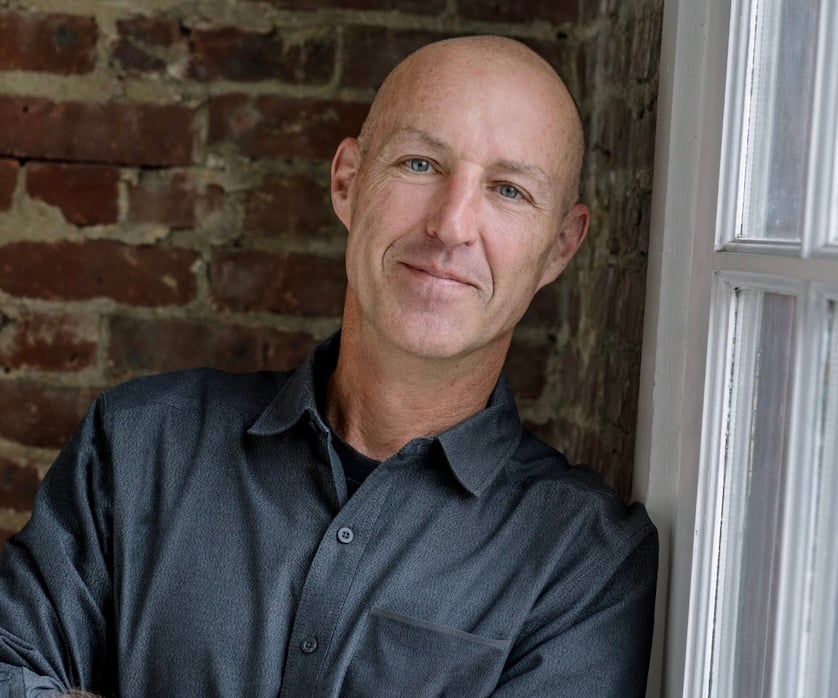




 Katerin Giambalvo, owner of Monticello Restaurant, addresses the Red Bank Borough Council. (Photo by Brian Donohue. Click to enlarge.)
By BRIAN DONOHUE
 John “Johnny Pork Roll” Yarusi set what is believed to be a new record for F-bombs at a Red Bank Borough council meeting during his condemnation of the Broadwalk pedestrian plaza. (We counted three). (photo by Brian Donohue)
“I’ve never felt this struggle in 16 years until now,” said Katerin Giambalvo, owner of Monticello Restaurant, at 69 Broad Street, a block and a half south of where the street is closed to traffic all summer.
Total business is down 50 percent, she said. And while Giambalvo said before Broadwalk began, Monticello’s business was comprised of 70 percent reservations and 30 percent walk-ins, she added, “After the Broadwalk closing, I lost all of my walk-ins.”
“Nobody is coming further up into the town to come and check out different menus,” she said. “Everything is about Broadwalk: music, marketing, everything is all focused down there.”
John Yarusi, owner of Johnny’s Pork Roll and Coffee Too on Monmouth Street, (who identified himself as “John Pork Roll”) argued that consumers were creatures of habit and the traffic closure disrupts business for places like his which rely on people making a quick stop for their morning coffee or quick bite.
“I adore this town but this Broadwalk thing is bullshit and it’s got to stop. It makes no sense,” Yarusi said. ” I can’t tell you the amount of people, residents and business owners, who come into my store who say as much.”
Several members of the governing body, who voted unanimously last year to make Broadwalk a permanent annual feature, said they still think the benefits far outweigh any downsides.
But they expressed a willingness to tweak aspects of the plan, such as the hours downtown parking fees are charged, to help businesses outside the zone. 
“I am not in favor of shutting Broadwalk down,” Mayor Billy Portman said. “But I am in favor of treating it as a living, evolving thing.”
Several of the five business owners who addressed the council argued that while Broadwalk was a boon for businesses located directly on the plaza, it has siphoned business from their eateries, which sit just outside the zone, or in the case of the Red Bank Diner, as far as seven blocks south.
But that argument was countered by Tim McCloone, owner of Robinson Ale House, located directly on Broadwalk. He credited the street closing with a $300,000 increase in sales for each of the last two years. “It was a breakthrough for us,” he said.
Restauranteur Tim McCloone addresses the Mayor and Borough Council. (photo by Brian Donohue)
But this year, he said, businesses just outside the Broadwalk area are far from alone in seeing a dropoff in business.
Of the ten restaurants he owns across New Jersey, business is down at eight of them, including Red Bank. McCloone said a string of 11 rainy weekends from the late spring into summer was likely a large factor.
“Could there be adjustments made to Broadwalk? Absolutely,” McCloone said. “Maybe it should start later, maybe it should end sooner.”
Mairin Bennett, executive director of Red Bank RiverCenter, the business improvement district that manages Broadwalk, called the notion that the plaza hurts business “a false narrative.” She cited other trends possibly at work, including consumers being squeezed economically.
“You have to look at all the variables that are going on here,” she said.
She cited RiverCenter’s use of a service that tracks visitors’ cell phone location data, she said shows people who go to Broadwalk and also walk around to other parts of the town.
The stretch of Broad Street between White Street and Front Street was first closed to vehicles in 2020 to provide eateries more space for outdoor dining during the pandemic.
It was continued in the following years and made permanent by an ordinance passed unanimously by the council in 2024. It is seen largely as a way to create an experience that competes with towns like Long Branch and Asbury Park whose once-decrepit boardwalks have re-emerged as regional destinations in recent years.
Louis Andrianos, owner of Neapoli Italian Kitchen on Wallace Street just off Broad Street, blamed Broadwalk for 2025 being “by far the worse year we’ve seen.” He said he pulled together the group of business owners to approach the council to seek its end or curtailment.
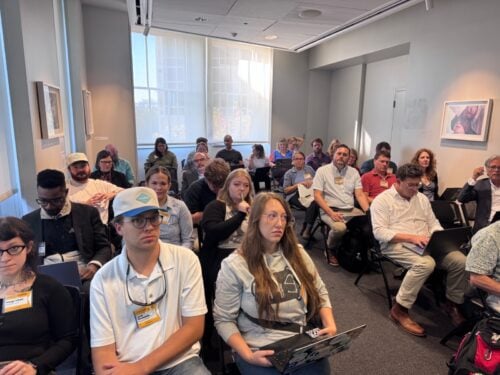
The group of restaurant owners who came to address problems they say are created by Broadwalk. (photo by Brian Donohue)
“Red Bank makes it very difficult for us that are not on the Broadwalk,” he said. “It makes it difficult for us to fill up our venues.”
McLoone challenged people asking for the end of Broadwalk what other ideas they had to pull customers in from surrounding areas. He said just that afternoon, a hostess at Robinson Ale House had just told him how she’s meeting people from all over the region while on the job.
“That almost stands for itself,” he said. “She’s meeting people from other states and other areas of this state. That was theoretically the idea of Broadwalk.”
Deputy Mayor Kate Triggiano, the council’s liason to RiverCenter, said the organization had been “in discussion about ideas that could bring equity into the other areas” around Broadwalk.
She said data collected by RiverCenter shows more visitors to the town, which would boost the economy.
“We have to be careful not to operate on a scarcity mindset,” she said. “More people boost your economy.”
redbankgreen editor Brian Donohue may be reached via email at [email protected] or by calling or texting 848-331-8331 or yelling his name loudly as he walks by. Do you value the news coverage provided by redbankgreen? Please become a financial supporter if you haven’t already. Click here to set your own level of monthly or annual contribution.